Offshore corrosion inspection: from visible damage to repair decisions
Rust is a starting observation, not a remaining-strength calculation. Offshore corrosion inspection must establish what has deteriorated, how that affects the load path and what information is still missing. For Namibian marine operators and offshore project teams, a useful survey supports a defensible repair decision rather than simply producing photographs.
Section 01Identify the mechanism and affected function
Separate general thinning, local pitting, crevice attack and coating breakdown in the record. Damage near a connection, pipe support or highly loaded plate can have a different consequence from visually similar damage elsewhere. Describe the component’s function and exposure before assigning priorities.
Salt contamination, trapped moisture and inaccessible surfaces can complicate coastal steelwork maintenance around Walvis Bay. These are exposure considerations, not proof of a particular corrosion mechanism on an individual asset. Confirm the operating history and involve corrosion specialists where needed.
Section 02Plan measurements that answer the engineering question
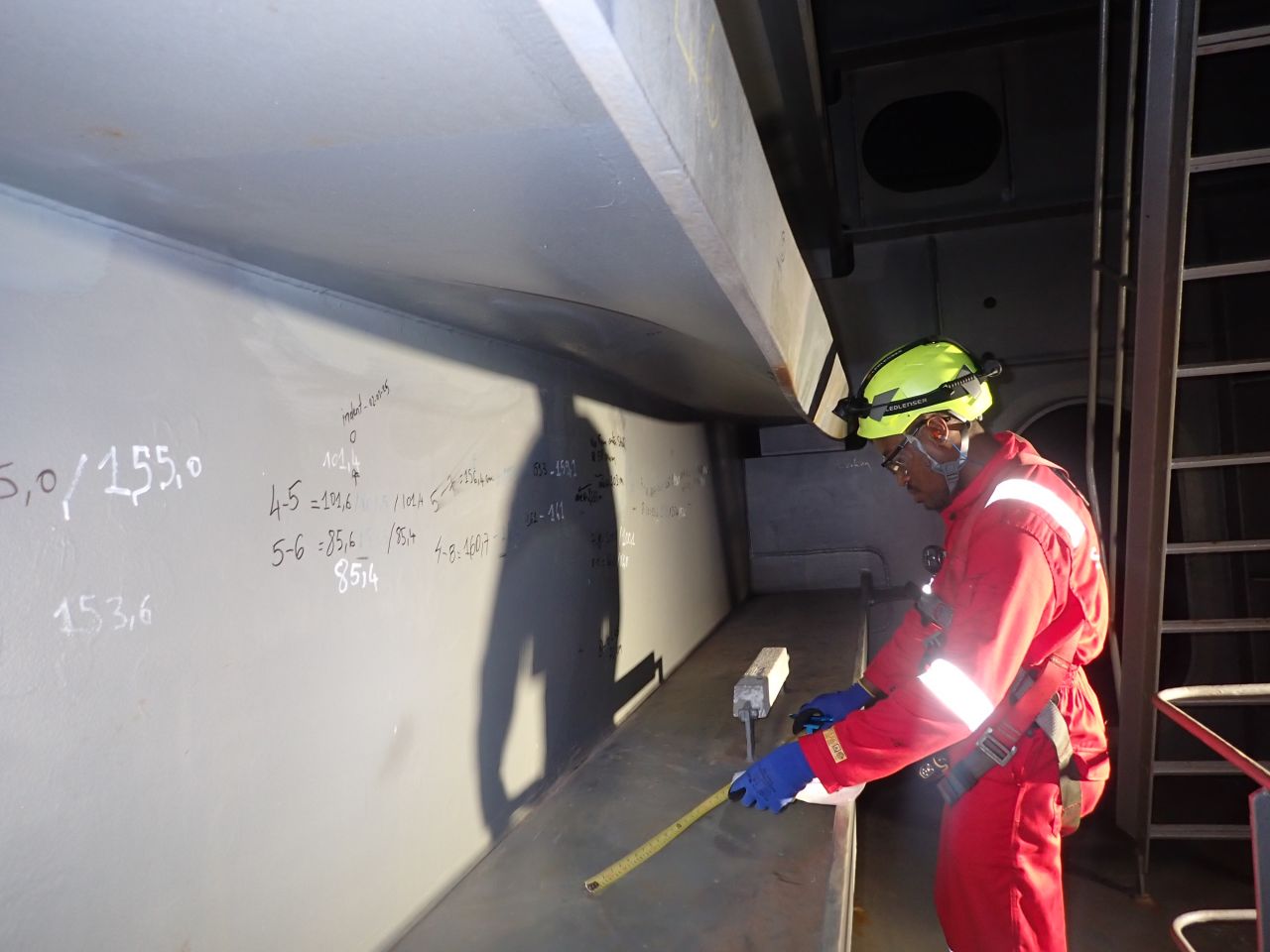
A thickness survey needs identifiable locations, an agreed coverage plan, suitable equipment and qualified personnel. Isolated readings may miss local defects or fail to describe a corroded connection. Record nominal thickness where verified, measured values, limitations and inaccessible areas.
Coating condition, surface preparation and geometry influence measurement reliability. A visual survey cannot establish subsurface cracking, and a thickness reading alone does not determine acceptance. Further inspection should follow the damage mechanism and applicable assessment basis.
Section 03Assess the complete load path
Remaining plate, stiffeners, welds and adjoining supports act together. An assessment should consider actual loading, section loss distribution, stability and whether the original structural assumptions still apply. A percentage of lost thickness is not a universal rejection criterion.
My documented offshore work includes corroded oxygen-scavenger skid structures and deck-plate replacement surveys on FPSOs. These illustrate why the output must link condition to reinforcement or replacement requirements; they do not establish a common repair detail for every skid or deck.
Section 04Compare repair and protection options
Options may include monitoring, protective-system renewal, reinforcement or replacement. Selection depends on verified integrity, service conditions, expected life, installation access and owner or class requirements. Painting over rust does not recover lost structural capacity.
Specify how the repaired area will be inspected and maintained. If corrosion continues at an adjacent detail or beneath an inaccessible repair, the intervention may move the problem rather than resolve its cause.
Section 05Prepare an actionable handover
A corrosion report should identify defects by location, include measurement records and distinguish observed facts from engineering interpretation. Urgent findings need escalation through the asset’s integrity process rather than waiting for the final report.
- Condition map and traceable photographs.
- Measurement coverage, uncertainty and unverified areas.
- Assessment basis and repair priorities.
- Follow-up inspection and maintenance responsibilities.