Industrial equipment supports: designing steelwork around real machine loads
Heavy equipment does not always load its supporting steelwork like stored goods. Operating forces, start-up conditions, vibration and equipment alignment may control the design. Supporting frames and platforms need verified supplier inputs and coordination with the machine and foundation specialists.
Section 01Obtain usable equipment information
Request equipment mass, centre of gravity, attachment geometry and operating actions from the supplier. Ask for relevant start-up, shutdown, maintenance and abnormal conditions. A single total weight may omit the forces that govern support design.
Pumps, compressors and other industrial machines illustrate this engineering problem. The article is educational; it does not imply documented design experience for every machine, processing plant or heavy-industry installation mentioned.
Section 02Distinguish static and dynamic assessment
Dynamic response depends on forcing, mass, stiffness and damping. A static strength calculation alone cannot establish acceptable vibration. Equipment-sensitive structures may need specialist dynamic analysis and criteria agreed with the vendor.
Avoid treating an arbitrary impact allowance as a substitute for missing machine data. Where information is incomplete, state the limitation and request verified inputs before finalising the support. Operational changes can affect the original assessment.
Section 03Trace reactions into connections and foundations
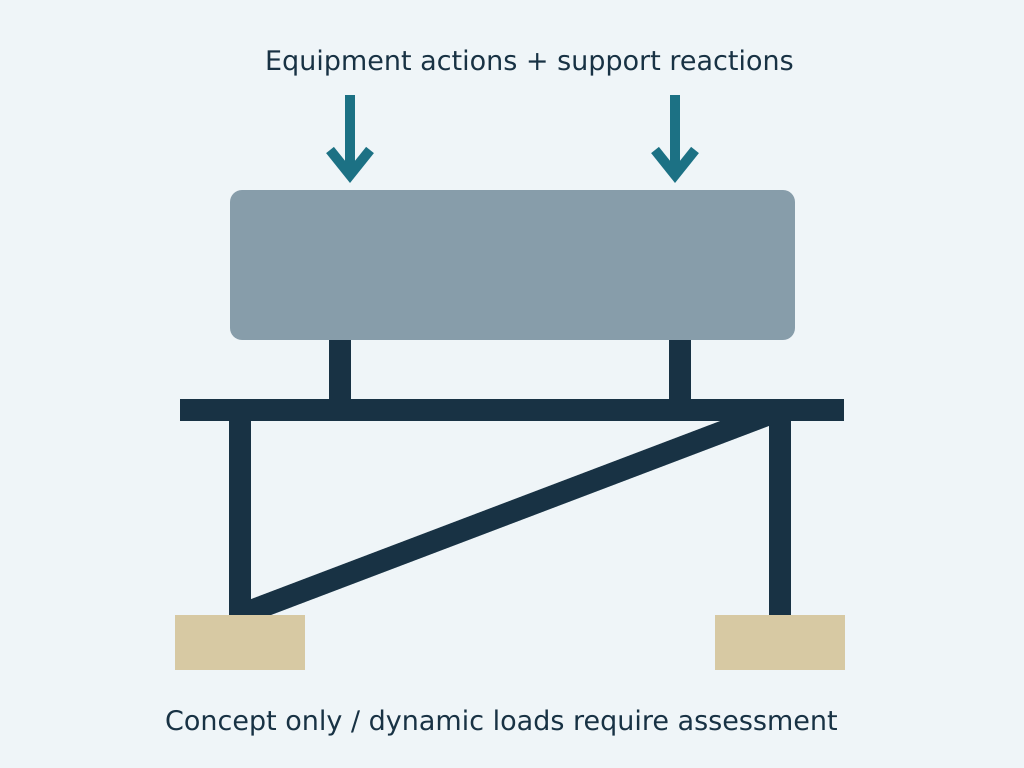
Steel frames distribute equipment actions into supports and anchors. Verify local plate behaviour, member stability and connection force transfer as well as the overall frame. Supporting foundations need the appropriate reaction information and ground assessment.
Equipment nozzle or connection loads may also be affected by support movement and attached services. Coordinate piping and structural assumptions so the machine is not forced into alignment with a frame or pipework that moves differently.
Section 04Design for access and maintenance
Platforms, stairs and removable sections should allow inspection and equipment servicing without undermining structural performance. Confirm lifting and removal envelopes. Where equipment is replaced during maintenance, the temporary loading and handling arrangements need their own review.
Durability and inspection access matter throughout the service life. Drainage, protection systems and accessible connections can make later condition assessment more reliable, particularly in coastal industrial environments.
Section 05Communicate limits and verification requirements
The design package should identify the equipment basis, assumptions and interfaces awaiting supplier confirmation. Changes to equipment model, operating speed or attachment layout should go through engineering review. For Namibia projects, early coordination between owner, vendor and fabricator helps prevent unsupported substitutions.
- Vendor loads and operating conditions.
- Agreed vibration and alignment criteria.
- Steel, connection and foundation assessment.
- Maintenance access and equipment change controls.
Related
- Steel base plates and anchor bolts: coordinating the foundation interface
- Onshore structural engineering in Namibia: from industrial brief to steel design
- Marine piping and pump selection: matching the system duty, not just the flow rate
- Onshore, industrial and offshore structural engineering in Namibia