What makes an offshore structural survey useful for repair design?
A useful offshore structural survey connects observed condition to a clearly defined engineering decision. Photographs alone rarely provide enough information to design a replacement or reinforcement. This guide explains what to capture, how to document uncertainty and what an office design team needs from the field.
Section 01Start with the decision, not the camera
Define whether the assignment supports replacement, reinforcement, dimensional verification or a wider condition assessment. Identify the structures and boundaries included, the loading information available and the authority responsible for accepting the engineering outcome.
A damaged grating, a deformed hull area and a corroded tank support are different problems. Their inspection methods, geometry requirements and deliverables should not be copied from the same generic checklist.
Section 02Record geometry and condition together
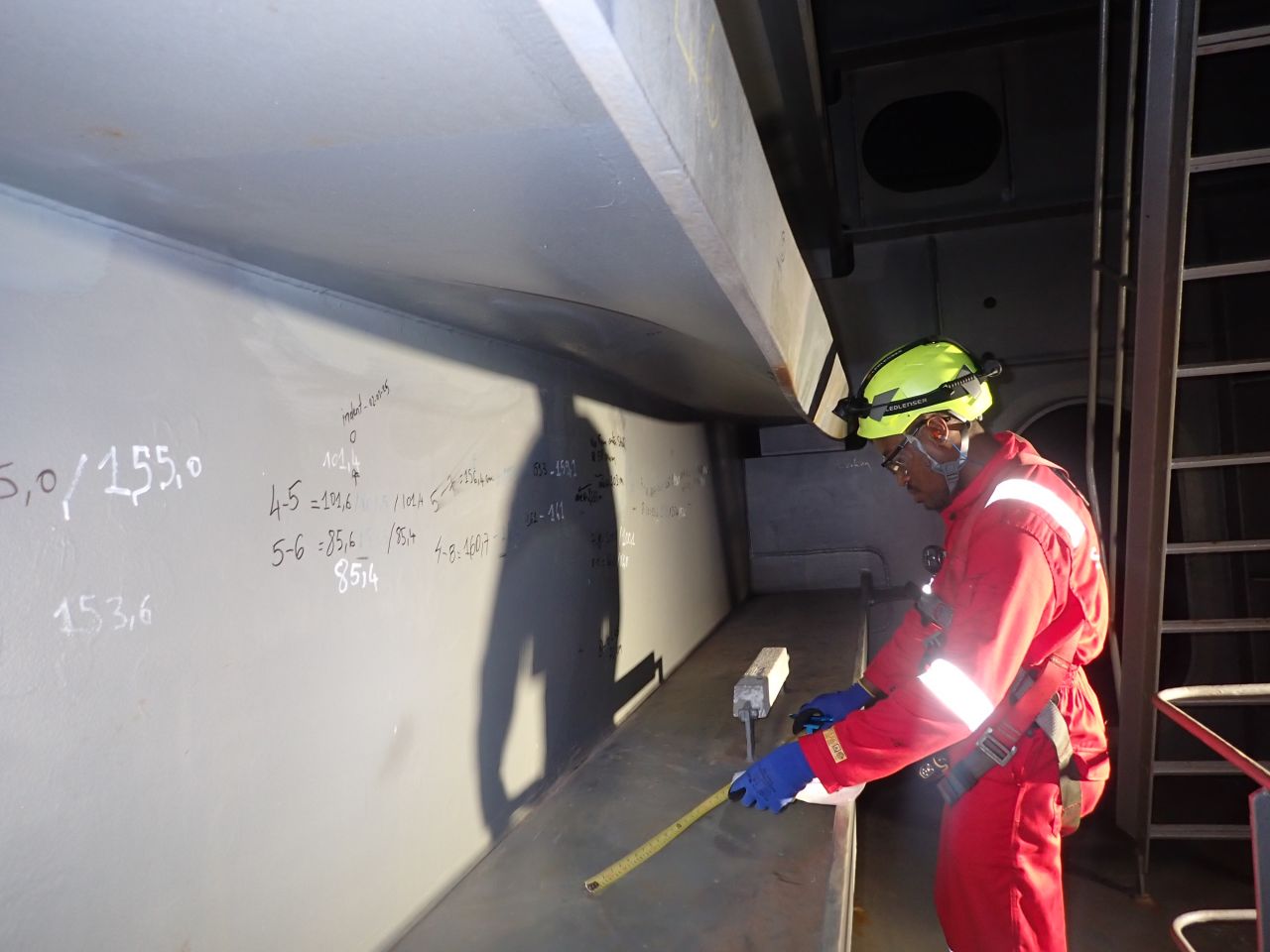
Capture dimensions, support points, connections, material information where available, visible damage and the surrounding equipment interfaces. Use an identifiable datum and mark the location of each finding so measurements can be traced back to the asset.
Distinguish a measured value from an estimate. Record areas that were inaccessible, obscured or excluded from the survey. An explicit limitation is more useful than an apparently complete report that conceals a gap.
- Overview and detail photographs with location references.
- Measured geometry and connection arrangements.
- Corrosion, distortion, cracked or missing components and evidence requiring investigation.
- Drawing revisions and observed deviations from available plans.
Section 03Plan NDT around the engineering question
Thickness measurements, ultrasonic testing and magnetic-particle inspection provide different types of evidence. The selection, coverage, personnel qualification and acceptance criteria must follow the project’s inspection plan and applicable requirements.
My jack-up rig survey experience included directing NDT technicians while surveying ballast tanks and primary and secondary structures. The purpose was to connect the findings to structural reporting, repair models and drawings—not to treat a single test result as a complete structural assessment.
Section 04Use laser scanning where it adds value
3D scanning is useful for congested pipework, deformation mapping and geometrically complex replacement areas. It can capture information that is difficult to reconstruct from a few manual dimensions.
However, a point cloud does not establish wall thickness, material grade or fitness for service by itself. Line-of-sight gaps, scan registration and reference geometry need checks. Communicate data quality and the areas requiring manual verification.
Section 05Survey the replacement route as well as the component
A technically sound replacement may be impossible to install without considering access hatches, lifting routes, laydown space and surrounding services. Document those constraints before the office team finalises a solution.
Hydrophore vessel survey work on FPSOs included replacement-versus-in-situ lining options, hatch and route constraints, laser scanning and method statements. The installation constraints were part of the engineering problem, not an afterthought.
Section 06Deliver findings that the next engineer can use
A repair-oriented report should identify the asset, survey purpose, methods, findings, limitations and recommended next steps. Drawings and scan references should use consistent identifiers. Separate immediate observations from recommendations requiring calculation or approval.
Offshore entry, isolations, confined spaces, rope access and working at height require authorised procedures and competent personnel. This article is a documentation guide, not a permit-to-work instruction or an inspection acceptance standard.